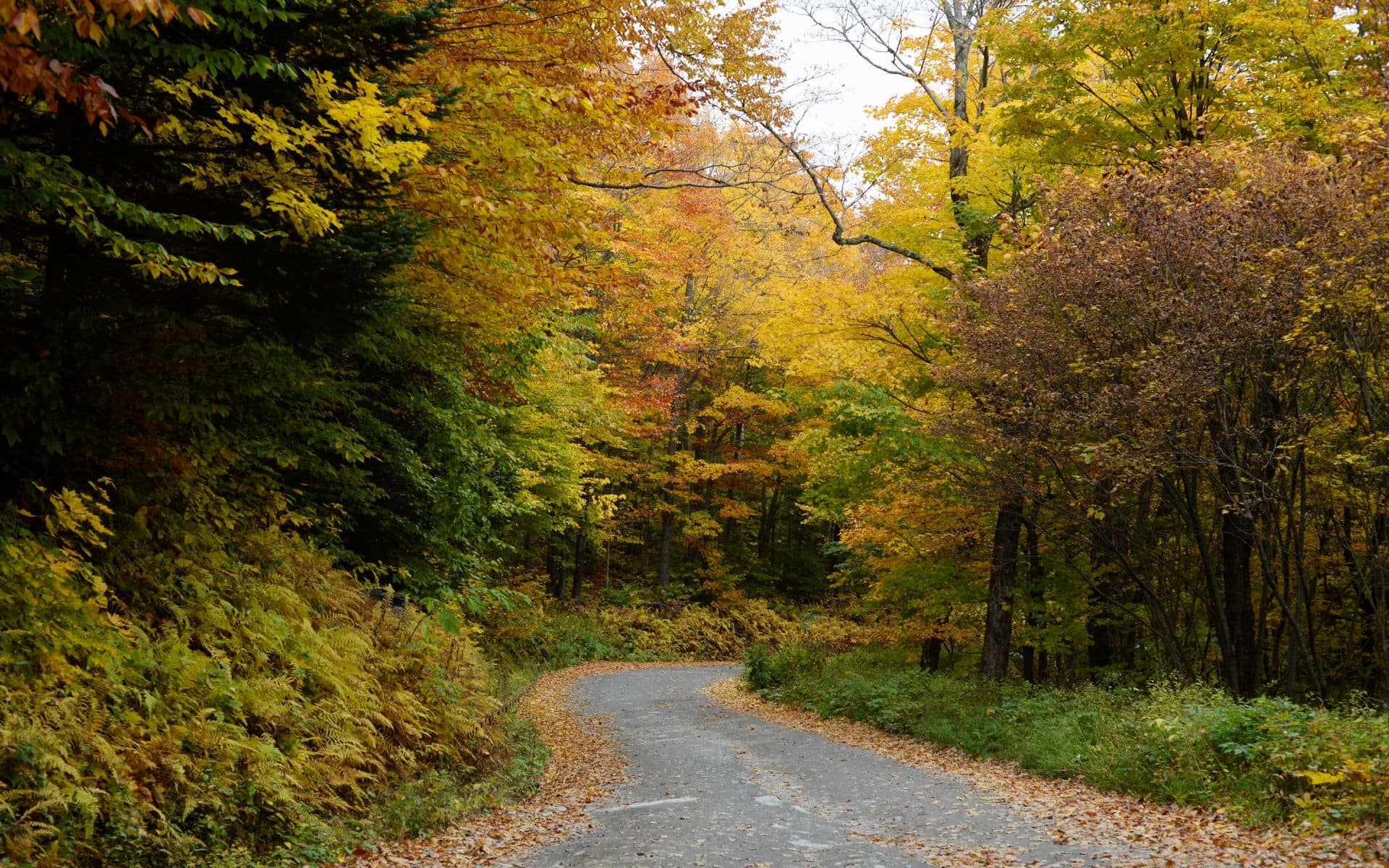
Overview
Vermont draws leaf-peepers from across the Northeast because it concentrates something other states spread thin: a dense mix of sugar maples that turn deep orange-red, American beech that goes gold, and paper birch that flares yellow, packed tight along mountain slopes and farm hollows from one end of the state to the other. The result is a color intensity that rewards the drive in a way that more diffuse foliage landscapes don't. The Vermont Travel Guide covers all six regions of the state, and fall is the season that ties them together.
The Green Mountains run the full length of Vermont from north to south, which means Route 100, the 216-mile spine road from Readsboro in the south to Newport in the north, keeps you in foliage at eye level and above for the entire drive. The Northeast Kingdom in Vermont's far northeast corner, covering Orleans, Caledonia, and Essex counties, turns first. High terrain like Mount Mansfield at 4,395 feet above Stowe begins showing color at the ridgeline as early as the first week of September. The valleys around Manchester and Brattleboro in the south are last, typically peaking in the second or third week of October. That spread gives you a window of almost four weeks during which some part of Vermont is at or near peak, which makes it possible to time a trip well even with a few weeks' notice.
What to Expect
The foliage experience in Vermont is mostly a driving one. Vermont's two-lane roads, Route 100, Route 2, Route 4, and Route 5A, are the right pace for watching color. You move slowly, stop in villages to walk the common, eat at a general store or diner, and pull over at covered bridges and farm stands along the way. The crowds at popular spots are real during peak foliage weekends. Stowe village, the Woodstock green, and Route 12 north of Montpelier fill up on the best October Saturdays. Plan to park a few blocks off the main street and walk in, and expect that the most famous viewpoints will have other people at them. The Northeast Kingdom towns, by contrast, tend to be genuinely quiet even at peak.
The color sequence, if you pay attention, goes like this: sumac turns red first, often by mid-September even at lower elevations. Sugar maples follow with orange and red, and they are the dominant visual note along Vermont's mountain roads. Beech and birch turn gold and yellow and hold their color a week or two longer than maples, which means mid-October drives can still offer striking views in the right hollows, even after the most popular foliage weekends have passed. This is worth knowing if your schedule is inflexible, because a trip on October 15 or 16 is not a wasted trip.
Pairing foliage drives with hiking the Long Trail or its side paths makes the day feel layered rather than passive. On the Stowe corridor, you can hike a stretch of the trail on Mount Mansfield in the morning, drive Route 108 through Smugglers Notch in the afternoon (the notch road itself takes 30 to 45 minutes at the pace it demands, with 1,000-foot rock walls and tight bends), and end the day at a brewery. Idletyme, a brewery and cidery on Mountain Road in Stowe, has a patio that faces the surrounding slopes directly, and during the first week of October the view from it earns the stop on its own. If you're starting from Burlington, Foam Brewers sits on the waterfront at 112 Lake Street with outdoor seating that faces Lake Champlain, making it a natural starting or ending point for a foliage day heading east on Route 2.
Best Season
Foliage timing in Vermont is elevation- and latitude-dependent, and it shifts 5 to 10 days in either direction from year to year depending on the August and September temperature pattern. A warm, dry September delays color. Cold nights in late August or early September push it earlier. These ranges are based on typical patterns across recent seasons.
| Region | Key towns and roads | Typical peak window |
|---|---|---|
| Northeast Kingdom | St. Johnsbury, Newport, Lake Willoughby (Rte. 5A) | Sept. 25 – Oct. 5 |
| Stowe & Northern Green Mtns | Stowe, Mount Mansfield, Smugglers Notch, Rte. 108 | Oct. 1 – 10 |
| Central Vermont | Killington, Mad River Valley, Montpelier, Rte. 100 | Oct. 5 – 14 |
| Upper Valley | Woodstock, Quechee, Ottauquechee River, Rte. 4 | Oct. 5 – 15 |
| Southern Vermont | Manchester, Stratton, Brattleboro, Rte. 7A | Oct. 10 – 20 |
The Vermont Department of Forests publishes a weekly foliage report from mid-September through mid-October, and it is the most reliable real-time guide for knowing where the color is on a given weekend. Local innkeepers are a close second: they track conditions daily and will tell you which roads looked best that morning. If your dates are fixed, consider targeting the Northeast Kingdom for late September, where the peak is earliest and the crowds thinnest. Route 5A above Lake Willoughby, where the glacial lake sits between the cliffs of Mount Hor and Mount Pisgah, is one of the most dramatic foliage viewpoints in New England and rarely feels overcrowded even at peak.
Typical Costs
Driving Vermont's two-lane roads and looking at the trees costs nothing. Vermont state park day-use fees run approximately $4–$6 per person (estimate; check the Vermont State Parks site for current rates). The Stowe Mountain Resort gondola to the summit of Mount Mansfield costs roughly $35–$45 per adult in the fall season (estimate; confirm on the resort website before visiting). The Mount Mansfield Auto Toll Road, a 4.5-mile unpaved road that climbs to the Nose, costs approximately $20–$25 per vehicle (estimate; access hours in fall vary, so confirm with the resort before planning around it). Most covered bridges are free roadside stops, and the back roads between them are open to all.
Lodging is the significant cost of a foliage trip. Vermont inns along Route 100 and in Stowe, Woodstock, and Montpelier raise rates sharply during peak October weekends. Budget approximately $200–$350 per night at a well-located inn or B&B during peak (estimate), and up to $400 or more for the better Stowe properties on the prime first weekend of October. Midweek stays in the second or third week of October cost considerably less and the foliage is still strong in central and southern Vermont. Dinner at a Vermont farm restaurant runs roughly $25–$45 per person (estimate). A pint at The Alchemist Brewery in Stowe or at Foam Brewers in Burlington runs approximately $8–$12 (estimate), and both are worth the stop on a foliage drive through their respective towns.
How to Book and Plan
Reserve lodging 4–6 weeks ahead for the first two weeks of October, and earlier if you're targeting Stowe or Woodstock on a weekend. Fly into Burlington International (BTV) for access to the northern Green Mountains, the Northeast Kingdom, and Stowe. Burlington is about 45 minutes from Stowe by car on Route 89 north to Route 100. If you're targeting southern Vermont around Manchester or Stratton, Albany (ALB) cuts driving time from the south, and Boston Logan (BOS) is a reasonable drive to the Upper Valley around Woodstock. A rental car is required; there is no practical way to do a Vermont foliage trip without one.
For specific driving routes, the best fall foliage drives in Vermont covers the roads worth building a trip around: Route 100 through the heart of the state, Route 5A above Lake Willoughby, the Lamoille River corridor on Route 15 west of Morrisville, and Route 4 from Woodstock through Quechee Gorge. If you have four or more days, the Vermont fall foliage road trip itinerary builds these into a loop covering the Northeast Kingdom, the north-central Green Mountains, and the Upper Valley. For breweries and operators to work into your itinerary, the Vermont breweries and tour operators directory lists cideries, guided foliage tours, and stops across the state by region. Combining foliage drives with Vermont's brewery and cidery scene is a natural pairing: hard cider production ramps up in September and October right when the apples come off, and many cideries sit on farm roads where the drive in is part of the experience.
Frequently asked questions
When is peak fall foliage in Vermont?
Peak timing varies by region. The Northeast Kingdom, including St. Johnsbury and the Route 5A corridor above Lake Willoughby, typically peaks in late September to the first few days of October. The Stowe and northern Green Mountains area peaks in the first to second week of October. Central Vermont, including Killington and the Mad River Valley, and the Upper Valley around Woodstock follow in the second week of October. Southern Vermont around Manchester and Brattleboro reaches peak in the second to third week. The Vermont Department of Forests publishes a weekly foliage report during the season, and it is the most accurate guide for real-time conditions.
What roads are best for Vermont fall foliage?
Route 100, which runs 216 miles through the Green Mountains from Readsboro to Newport, is the backbone foliage road and worth at least a two-day drive in its entirety. Route 5A along Lake Willoughby in the Northeast Kingdom is one of the most striking foliage viewpoints in New England, with the glacial lake framed between the cliffs of Mount Hor and Mount Pisgah. Route 108 through Smugglers Notch near Stowe is dramatic but narrow, with 1,000-foot cliffs on both sides, and it takes 30 to 45 minutes to drive at the pace the road demands. Route 4 between Woodstock and Quechee follows the Ottauquechee River through covered bridge country and includes a stop above Quechee Gorge.
How far in advance should I book lodging for Vermont fall foliage?
Book at least four to six weeks ahead for peak weekends in early to mid-October, particularly in Stowe, Woodstock, and the Northeast Kingdom. The most popular inns along Route 100 and in Stowe fill for the first weekend of October by August in a typical year. Booking midweek stays or targeting the third week of October, after peak in most of the state, is the most reliable way to find availability without a months-long lead time. If you book late, the Northeast Kingdom tends to have more last-minute availability than the more visited parts of the state, and it peaks first.
Is a Vermont foliage trip worth it if I can only go for a weekend?
Yes, but picking the right region for your specific dates matters more than the length of the trip. A long weekend in the Northeast Kingdom in late September or in the Stowe area in early October gives you a complete foliage experience on a two-day drive. Come with a rough plan of two or three roads you want to cover, lodging booked well in advance, and flexibility to adjust based on where the color looks best when you arrive. The weekly state foliage report and your innkeeper are the best ground-truth sources once you're there.