Overview
Vermont sets roughly 6 million tapholes each spring, pulling sap from sugar maples across Washington, Addison, Caledonia, and Orleans counties, along the ridge roads of the central Green Mountains, and up through the Northeast Kingdom toward the Canadian border. The production depends on a single, repeatable weather pattern: nights in the low 20s, days in the upper 30s to low 40s. That freeze-thaw cycle draws sap up from the root system and out through the taphole. Without it, the season ends early or never gets started. A warm February can close a sugarbush before March arrives.
Drive Route 12 south of Montpelier or Route 14 through the hill towns of Orange and Washington counties and you will pass sugarbush after sugarbush, hillside wood lots where sugar maples grow thick enough to run pipeline tubing between them. The Northeast Kingdom counties of Caledonia, Essex, and Orleans hold the densest stands of wild maple in the state, and many of the largest producers operate somewhere in that north-central corridor. Smaller family operations spread across every county, and it is common in the central and northern parts of the state to pass a roadside sugarhouse sign within minutes of leaving the interstate. For a broader orientation to Vermont's regions and the season rhythms that connect them, the Vermont Travel Guide covers all six areas of the state.
The technology inside a sugarhouse has changed considerably over the past century, from iron kettles over open fires to stainless steel evaporators and reverse osmosis concentrators, from hand-carried sap buckets to vacuum-assisted plastic tubing systems that draw sap from hundreds of trees automatically. The fundamental act of collecting and boiling sap down to syrup has not changed. What you are watching at an open sugarhouse is the same process Vermont farmers have run since the 1700s, scaled and refined.
What to Expect at a Vermont Sugarhouse
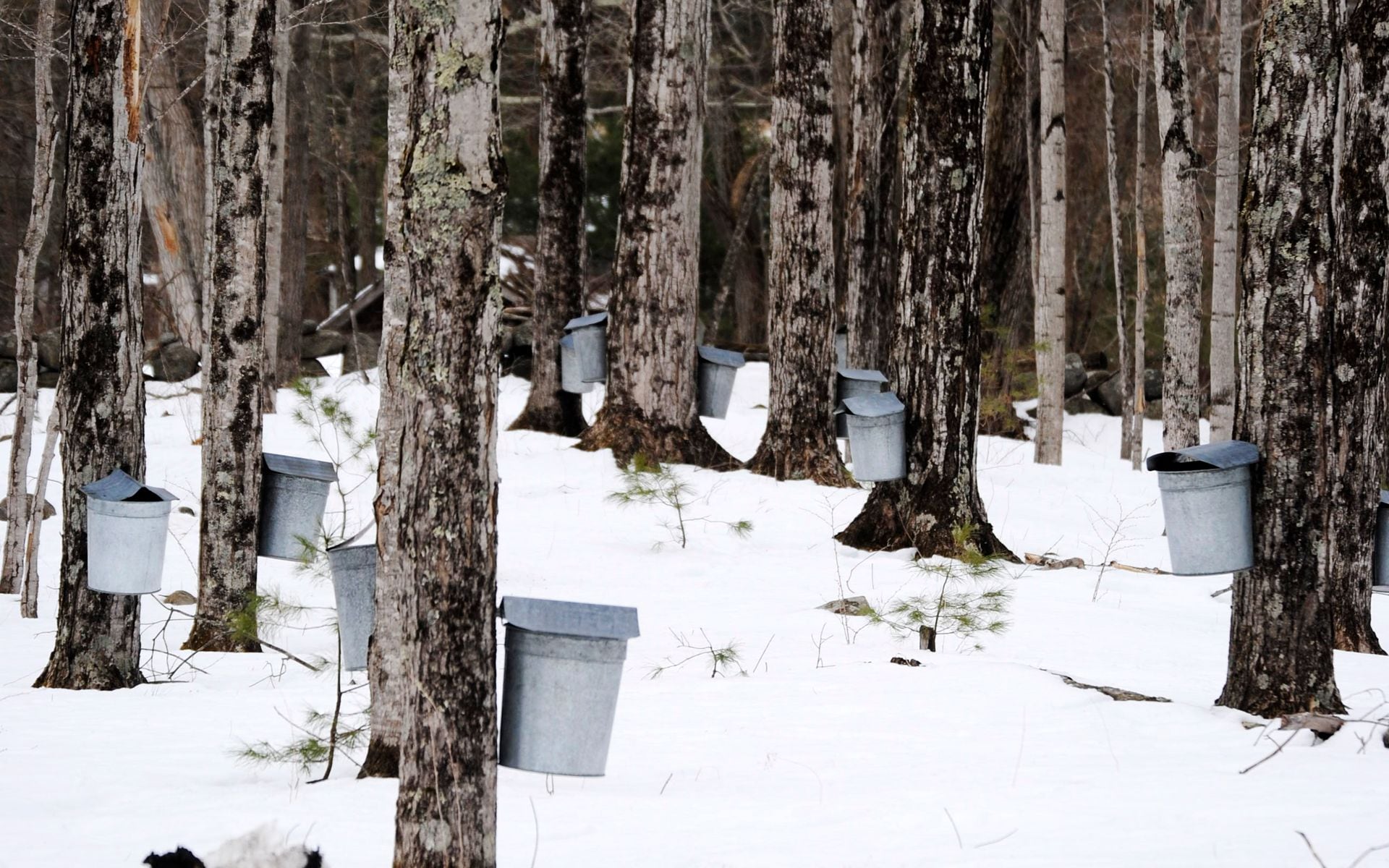
Most Vermont sugarhouses welcome visitors during the boiling season without a reservation. What you find when you arrive depends on the size of the operation. A small family farm may have a few hundred taps on traditional metal buckets hung from trees around the property. A large commercial operation runs vacuum-assisted plastic tubing between thousands of trees across the hillside, with automated collection flowing directly into the sugarhouse. Both systems produce syrup; the tubing just does it faster and with less labor.
Inside, the evaporator is the center of the operation: a long metal pan divided into sections, with a firebox beneath it burning wood. Sap enters at one end, flows through the sections as it concentrates, and exits as finished syrup at the other. The reduction ratio is approximately 40 gallons of sap to one gallon of finished syrup. The building fills with steam. The smell inside is faintly sweet and slightly green, not the heavy caramel you might expect from the finished product. Most farm stands offer a taste of fresh sap straight from a bucket or the line. It is nearly colorless and barely sweet, closer to water than to anything you would put on a stack of pancakes.
Vermont standardized its maple grade labels in 2015, replacing the old Fancy and Grade B categories with a four-level color and flavor scale: Golden (delicate), Amber (rich), Dark (robust), and Very Dark (strong). The darker grades come later in the season as the chemistry of the sap shifts. If you want to understand the difference firsthand, most farm stands will pour a small taste of each grade side by side. Darker grades carry more complexity and depth, and many cooks prefer them for baking and savory glazes, while Golden and Amber work best poured straight onto food at the table.
Morse Farm Maple Sugarworks on County Road in Montpelier, about three miles from downtown, is one of the most accessible sugarhouse operations in the state. The farm has been in the same family for seven generations and is set up for walk-in visitors, with a sugarbush trail, a working evaporator visible during the season, and a farm store selling syrup by grade. For visitors based near Woodstock, Sugarbush Farm sits in Pomfret on a dirt road about four miles north of the village green, combining maple tastings with a small Vermont cheese selection in a working farm setting that stays open year-round.
The sugar on snow tradition is specific to the boiling season and worth seeking out at any sugarhouse that offers it. The farmer pours hot near-finished syrup over a dish of packed snow or shaved ice, where it cools into a pliable, taffy-like ribbon you pull up on a fork or stick. The standard Vermont way to eat it is with a dill pickle on the side, to cut the sweetness between bites. This is not a tourist invention. Vermonters eat it at home during sugaring season, the same way every year.
After a morning at a sugarhouse, the stretch of Route 2 through Waterbury places you in the center of Vermont's densest food corridor. Prohibition Pig on South Main Street in Waterbury puts maple to work in its menu in ways that go beyond simple drizzling, and the town sits roughly 20 minutes north of Montpelier and about 25 minutes south of Stowe, making it a natural lunch stop on a central Vermont sugaring loop. The Breweries, Cideries and Tours directory covers other local spots in the same region, including cideries using Vermont apples and breweries that work maple into seasonal releases.
Best Season for Maple Sugaring in Vermont
The sugaring window typically opens in late February and runs through early April. The exact dates shift by elevation and latitude each year. Sugarhouses at higher elevations in the Northeast Kingdom and along the Green Mountain spine often begin tapping a week or two before farms in the lowlands of southern Vermont. A sugarbush at 1,500 feet on a north-facing slope in Caledonia County may be running in late February when the Connecticut River valley farms near Brattleboro are still frozen. The full season at any single location usually lasts four to six weeks, and the peak production window, when sap flows fastest and most consistently, often lasts just two to three weeks within that span. A warm spell that pushes temperatures well above freezing for several days in a row can end the run abruptly. Early springs close the season early; cold, stubborn winters can push it into April.
The Vermont Maple Festival in St. Albans in Franklin County, held each April, is the main public celebration. St. Albans sits about 30 miles north of Burlington International Airport (BTV) in the Champlain Valley, and the festival draws visitors to the downtown with maple product tastings, cooking demonstrations, and sugar on snow stations throughout the weekend. It is a good way to sample products from dozens of Vermont producers in one place, especially if the sugaring season itself has moved quickly and most operations have already closed their evaporators for the year.
Vermont Maple Open Farm Weekend, organized by the Vermont Maple Sugar Makers Association and typically held the last weekend of March or first weekend of April, is the single best opportunity for visiting multiple sugarhouses in a day. Dozens of operations participate simultaneously across the state, and most offer free or very low-cost admission. The association publishes the participating farm map at vermontmaple.org each year. This event lines up well with a broader central Vermont drive: the same roads that carry you between sugarhouses in Washington and Orange counties also connect the covered bridges, farm stands, and village centers that appear on the Best Fall Foliage Drives in Vermont later in the year.
Typical Costs
Visiting a sugarhouse is free at almost every Vermont farm. The cost comes at the farm stand. An 8-ounce bottle of amber or dark syrup typically runs an estimated $10 to $15. A quart costs an estimated $25 to $40, depending on grade and that year's sap yield. A half-gallon runs an estimated $45 to $65 at most farm stores. Prices shift upward after a short season when sap totals run low. A long, favorable season with consistent freeze-thaw cycles tends to hold prices closer to the lower end of those ranges.
Guided tours, where farms offer them, typically cost an estimated $5 to $15 per adult for a walk through the sugarbush, a look at the evaporator in operation, and a taste of finished syrup. Events like the Vermont Maple Festival and Maple Open Farm Weekend are free to attend or charge a nominal event fee of around $5 for access to the festival grounds. Sugar on snow at a farm stand during the season usually runs $3 to $6 per serving (estimate), often including the customary pickle on the side.
Buying syrup directly from the farm is consistently less expensive than purchasing at a grocery store or gift shop, and the selection of grades is wider. If you are purchasing several grades for comparison or buying in quantity to bring home, the half-gallon and gallon tins from farm stores represent the best value per ounce and travel well when packed in checked luggage for the drive or flight home from BTV.
How to Book and Plan
Most Vermont sugarhouses operate on a walk-in basis. No reservation is needed to visit Morse Farm Maple Sugarworks in Montpelier or Sugarbush Farm in Pomfret. For Maple Open Farm Weekend, the Vermont Maple Sugar Makers Association at vermontmaple.org publishes the full farm list and an interactive map each year. You can build a half-day or full-day driving loop from that map based on where you are staying. Central Vermont offers the densest concentration of participating farms: the Route 12 and Route 14 corridors between Montpelier and Randolph connect eight to ten farms in a loop that takes three to four hours at a relaxed pace with stops.
The sugaring season ends roughly when the ice goes out on Lake Champlain, typically in early to mid-April, which marks the transition from mud season toward the warmer possibilities of late spring. If you are planning a longer Vermont stay that stretches from the sugaring season into May and June, the Lakes and Paddling guide covers what opens up as the lakes and rivers warm. The two activities rarely overlap on the same trip, but they connect naturally if you are spending a week or more in Vermont across the spring shoulder.
For scenic back-road routes that pass through maple country and connect Vermont's major travel corridors, the Scenic Drives guide covers the best two-lane roads in the state. Many of the routes in central and northern Vermont trace directly through the heaviest sugarbush territory. If you are combining a maple trip with fall travel or looking to understand the road network between sugarbush country and the Northeast Kingdom, the Vermont Fall Foliage Road Trip itinerary follows overlapping corridors and gives you useful routing context for any season.
Frequently asked questions
When is maple sugaring season in Vermont?
The Vermont sugaring season typically runs from late February through early April, though the exact window shifts by year, elevation, and location in the state. Higher-elevation sugarhouses in the Northeast Kingdom and along the Green Mountain spine often begin tapping a week or two before lowland operations in southern Vermont. The entire season at a single sugarbush usually lasts four to six weeks, and the peak production window, when sap flows most consistently, often spans just two to three weeks within that. A sustained warm stretch above freezing ends the run, so season length varies noticeably from year to year.
Can you visit a Vermont sugarhouse without a reservation?
Yes. Most Vermont sugarhouses welcome walk-in visitors during the boiling season. Morse Farm Maple Sugarworks in Montpelier and Sugarbush Farm in Pomfret, near Woodstock, are both set up for unscheduled visits, with farm stores and viewing areas open to the public. Vermont Maple Open Farm Weekend, held the last weekend of March or first weekend of April, is the most organized opportunity for multi-farm visiting, with dozens of farms opening simultaneously across the state. The Vermont Maple Sugar Makers Association publishes the farm map at vermontmaple.org each spring.
What are the Vermont maple syrup grades and what do they mean?
Vermont follows a four-level grade system adopted in 2015: Golden (delicate flavor), Amber (rich flavor), Dark (robust flavor), and Very Dark (strong flavor). The progression from Golden to Very Dark corresponds roughly to the progression of the season, with lighter grades produced earlier when sap sugar content is higher and the boiling is gentler. Darker grades develop more complex, mineral-forward flavors and are often preferred for cooking and baking. Golden and Amber are better suited to direct table use. Most farm stands offer a taste of each grade so you can decide what you prefer before buying.
What is sugar on snow and where can you get it in Vermont?
Sugar on snow is a Vermont tradition in which hot, near-finished maple syrup is poured over packed snow or shaved ice, where it cools rapidly into a pliable, taffy-like ribbon. You eat it off a fork or wooden stick, typically with a dill pickle on the side to cut the sweetness between bites. It is served at many sugarhouses during the boiling season, usually for a small charge in the range of $3 to $6 (estimate). The Vermont Maple Festival in St. Albans also features sugar on snow stations throughout the event weekend each April.
Where is the best maple sugaring country in Vermont?
The central Vermont hill towns along Route 12 and Route 14, between Montpelier and Randolph in Washington and Orange counties, hold some of the highest density of open sugarhouses in the state. The Northeast Kingdom counties of Caledonia, Essex, and Orleans have the most maple trees and the largest commercial producers, and operations there often begin tapping earliest in the season. For accessible, visitor-friendly farms, Morse Farm Maple Sugarworks in Montpelier and Sugarbush Farm near Woodstock in Pomfret are among the most established in the state.